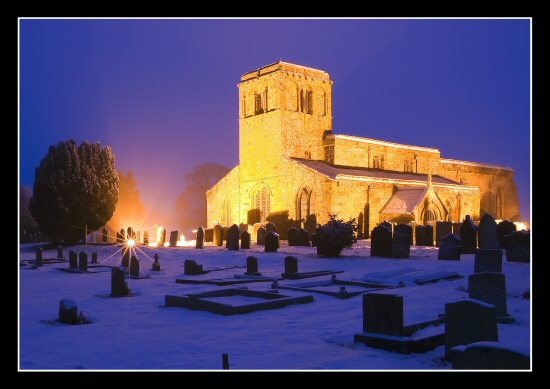
St. Mary the Virgin, Leake, North Yorkshire


What we do know is that the site is a very ancient one, already there was a church standing in Norman times. The west face of the Norman tower has a Saxon cross built into it; and this may well have been the original churchyard cross. It is the only bit of recognisable Saxon work to survive. There is no mention of Leake in the Anglo-Saxon Chronicle though it is recorded that at Over Silton the inhabitants burned Bern, their earloman, in the 9th century.
The Danish Legend
There is a local legend linking Leake with the Danish occupation. A track behind Leake Hall still bears the name "Dane's Lane". The women of Leake rose up against their Danish oppressors and slew them to the last man. This may well have been part of the general uprising planned by King Edgar when all over the country similar revolts took place, St. Brice's Day, November 13th 1002 A.D. Was this the first blow for women's lib when the women killed their Viking masters who had slaughtered their menfolk earlier? In 1852 a pit was found in the churchyard containing a great huddle of bones of at least 500 people. These may have been the bones of the Danish invaders or the bones of those who perished in the Black Death.
The Norman Influence
The squat tower pays tribute to the centuries of later Norman invaders. This and the arcade of Norman arches in the nave suggests that it was quite a considerable village that the church was built to serve.
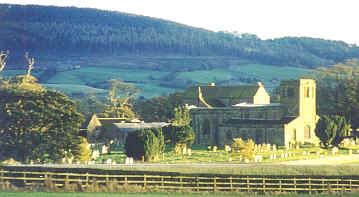
The tower contains 3 bells, one* of which has an interesting history. The men of Leake seem to have been successful snappers-up of unconsidered trifles of the Dissolution and this bell snatched from Henry VIII's melting pot was no mean acquisition. it has the legend "O PATER AELRED GRENDALE MISERERE" which may be translated "O Father Aelred pray for the sinners of Grendale".* Aelred was the third abbot of Rievaulx, 1147-67, not many miles away. Grendale was another Cistercian house a few miles south of Loftus, the site now known as Handale. Two possibilities suggest themselves. The first is that the bell was at Rievaulx at the time of the Dissolution and was the gift of the nuns (Grendale) to Rievaulx; the second is that the bell came from Grendale itself. Whichever is correct - and we shall never know - the bell remains a fascinating link with medieval times and is stated by Aelred's biographer to be the only medieval invocation of Aelred's prayers that he has ever found.
*JOHANNIS pe STASSORD (Stafford) the bellfounder worked 1338-1371, so this bell must date to his working life.
Bridlington Priory 'Loot'
Equally interesting and freshly visible is the wonderful pair of bench ends for the choir stalls in the chancel. These, too, are Dissolution "loot" and came from Bridlington Priory.

The Black Death
After the Norman period the church, like Topsy, "just growed' - presumably with the village, and contains work of every century up to the 15th. But in the 14th century something happened which caused Leake to cease to exist as a village, though not as a parish. Some say it was the Black Death, some that it was repeated raids by the Scots.

It could have been land exhaustion or death of stock on a large scale, or the fact that, after the Black Death, farm labourers were at a premium and the wages elsewhere were better than what was left after paying the Bishop of Durham his rent! But, again, we shall never know. The villages of Knayton and Borrowby grew as Leake declined and presently the church became the lonely building we know, as the surrounding timber houses decayed and fell. Save for the priest's house and Leake Hall, built in the 17th century, it was alone.
Though in Yorkshire, Leake was in the gift of the Durham Bishop - not that this availed the vicar very much since he was paid by the stipend only and the tithes were reserved "for upkeep of the Bishop's table". A house belonging to the Bishop stood on the site of the present farm building opposite the church gates and in this house the vicar had a suite of rooms, the rest being kept for the use of the Bishop on his journeys southwards. The parish was therefore, like Crayke further south, a little island of Durham in the midst of Yorkshire. It was the half-way house between York and Durham, a day's journey each way. Often the King and his court moved north to York. Richard Ill enjoyed the north very much and Middleham was his "Windsor" castle.
Points of Interest
Notice the carved capitals around the pillars in the North and South Aisles, and the bend in the arch above the visitors' book. Also high on the nave walls can be seen the older, earlier windows, subsequently blocked up.
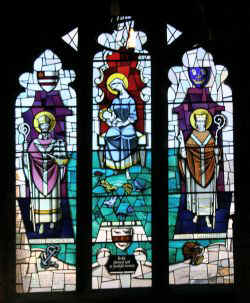
Windows: The East Window in the Lady Chapel was commissioned and installed during 1988 in memory of Lt. Col. Peter Consett's wife and his father. The rest are self-explanatory, but the figures in the East Window reflect the Christmas story by illustrating the Annunciation. Each sanctuary has a piscina or basin for ablutions. The name Leake is the same root as Lych or Lyke (Lyche gate) from the Norse word for corpse. Perhaps it was a dead or massacred village, or perhaps it is because it is near the end of the Lyke Wake walk route, (the footpath from around Bridlington via Rievaulx to Ripon that gives it its name) and so it attracted the furnishings of the monasteries and priories as they were dissolved. Many ex-monks became parish priests and took wives. Perhaps an early incumbent of Leake brought with him a few souvenirs of his mentor from the nearby abbey or bought them off a fellow cleric who went into the scrap business for a living when the monasteries closed!
Bibliography
"The Golden Vale of Mowbray' E. Bogg. pp. 185-190
WG. Collingwood "Anglian and Anglo-Danish sculpture in the West Riding,
with addenda to the North and East Ridings, 1915" pp. 129-99
"Vale of Mowbray" William Grainge, 1859, pp. 249-261
St Mary's Leake church website
Leake Hall is now the Farmhouse of G E Peacock and Son